On this page
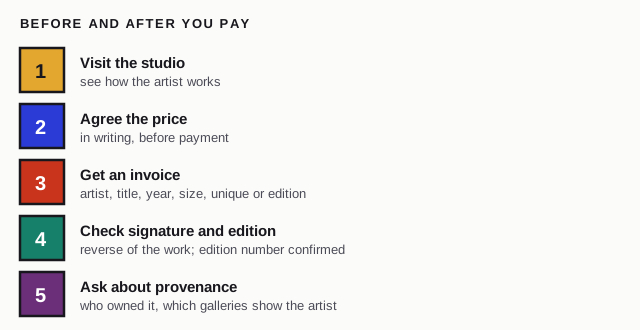
Buying from an emerging artist can cost less than buying an established name, but you carry more of the checking yourself, and the paperwork is only as good as you insist on. This guide, part of the wider buying guide, covers where to meet them, what to ask, what the invoice must say and how to pay.
What “emerging” means
In the Art Basel and UBS survey of global collecting, emerging artists are those who have been showing in galleries or museums for less than 10 years. Before you buy, find out where the artist stands: recently qualified or mid-career, trained at a respected art school or not, and whether buyers already pay what you are being asked. If you are comparing routes, the guide to where to buy affordable art covers the full list of places.
Why buyers look at emerging artists
Price is the main reason. Moving towards emerging artists allows you to buy quality art at affordable prices, and recently arrived artists can be bought at much more competitive prices than established ones. Early-career artists may offer a bargain as they look to build their client base and reputation. Young artists are usually easier to reach and eager for feedback, which makes the direct exchange part of the appeal.
The market has also been moving this way. New and emerging artists accounted for 52% of high-net-worth spending on art in 2023 and the first half of 2024. That is a fact about the market, not a promise about any one artist: speculative bubbles in young painters left many artists at best disappointed and at worst bankrupt. Buy for the work, not for a return: those just starting a collection should only choose pieces they truly love.
Where to find emerging artists
Degree shows
Final-year shows let you buy or commission work straight from graduates. Buying supports graduates early in their careers and secures an original piece from a new artist or designer. You agree a price with the graduate and collect the work or arrange delivery after the show. Talk to the individual about pricing and payment, or ask whether they have an online shop you can use in your own time.
Graduate prices can be low. The pound figures from a London graduate showcase and a charity sale are set out in where to buy affordable art.
Open studios
At an open studio event the artist’s workroom is opened to visitors so that work can be seen. You can meet working artists in every kind of medium, and most have something for sale and are happy to fit your budget. A studio visit also shows how seriously an artist works at their practice.
Fairs
Fairs are the route most collectors rank first: 55% ranked art fairs highest for discovering new and emerging artists. At Art Basel, the Discoveries sector is the place to look for emerging talent. For a lower ceiling, an Affordable Art Fair caps every price; the figure is on where to buy affordable art.
Museum rental and sales galleries
Some museums sell and rent work by local artists, which gives you a vetted route and a chance to live with a piece before you buy. In the UK the nearest equivalent is a gallery that takes Own Art; abroad, the Portland Art Museum and the Coos Art Museum run rental and sales galleries.
Social media and online
With so many artists promoting their work on social media, TikTok and Instagram are a source of inspiration. Once you know what you like, Instagram is an excellent way to get to know artists and see what they are working on, but it needs more checking than a studio visit: see the section below on buying from an artist you have only met online. Online platforms can also sell on an artist’s behalf. One platform’s terms warn that taxes and duties are not included in the purchase price, so check where the work will ship from before you pay.
Buying from an Instagram artist abroad
Instagram is a good place to find an artist and a risky place to pay one. A first purchase from a seller in another country is exactly where a scam or a lost parcel hurts most. Work through these in order.
Check the seller before you pay
If you are buying from a person you do not know and trust, research them first and ask a friend or family member for advice before you pay. Warning signs on a seller’s page:
- Stolen photos, inconsistent branding or captions copied from other stores. A real artist can show process: studio shots, work in progress, a video call.
- Pressure to pay quickly, move to another messaging app or avoid secure checkout.
- No website, return policy, order confirmation or verifiable contact details.
- A request to pay by bank transfer, crypto, gift cards or friends-and-family options, which are hard to reverse.
Verify the seller outside Instagram: look for a website, a gallery listing, a degree show page or a second social account, and check the payment method before you commit. Some fake sellers even send a fake tracking number to buy time.
Pay in a way that can be reversed
Swipe the table sideways to see every column.
| How you pay | What protects you |
|---|---|
| Credit card | Most major credit card providers insure online purchases. Section 75 covers a single item costing more than £100 and no more than £30,000, but it usually does not apply if you did not buy directly from the trader |
| Debit card | You can ask for chargeback, which is a card-scheme process your bank might decline |
| PayPal | A dispute can be opened within 180 days of paying; other payment methods are not obliged to give the same protection as a credit card provider |
| Bank transfer, crypto, gift cards, friends-and-family | Hard to reverse: avoid them for a first purchase |
Ask for a written invoice with the artist, title, year, dimensions and whether the work is unique or an edition, and keep the messages.
If the work never arrives
Write to the artist first and keep a copy. If they cannot be reached or will not help, ask your card provider or PayPal for your money back. If you think you were taken in by a bogus seller, note the account address, then report it to Report Fraud and contact your bank. The shipping guide covers packing, import VAT and carrier fees when the work does come from abroad.
Learn the market first
The old adage that knowledge is power applies to the art market as well, so aim to see lots of art in galleries and museums, read exhibition catalogues and art magazines, and visit art fairs. The best way to learn what art is currently selling for is to visit a number of different galleries and art fairs.
Trust your own eye over the crowd: buy what resonates with you, not what you hear is good. New collectors should also diversify, to develop a broader understanding of different styles and narratives in contemporary art. Open-studio events are a gentle way to start, because you simply talk to the people who made the work. When your own taste is clearer, Instagram becomes a sensible next route. Limited edition prints offer an excellent balance between affordability and collectibility if an original is out of reach.
Visit the studio
Plan the visit around the artist’s week. Most emerging artists have full and part-time jobs, so set aside 2-3 hours on a weekend afternoon. A visit is a chance to build a relationship that lets you follow their career if you decide to buy.
Check what you are buying
A sound sale leaves a paper trail, and what counts as proof depends on who is selling. A gallery or dealer should supply a certificate of authenticity or origin, and you should check it with the artist, the archive or the person authorised to speak for the work before you pay. A living artist selling directly may have no certificate to give, so the realistic proof is a written invoice that describes the work, a signature on the back and photos of it being made. Whoever you buy from, insist on the invoice or receipt: without it, a certificate or a signature is hard to tie to what you took home. If a certificate comes with a photograph, check that the picture matches the work in front of you.
Swipe the table sideways to see every column.
| Check | What to do |
|---|---|
| Signature | Ask the artist to sign the reverse of a painting; for a photograph, to sign and number the edition in pencil |
| Invoice | Get an email invoice if you pay in cash or by app |
| Invoice contents | The artist’s name, title, year, dimensions and edition status |
| Edition | Get the edition number confirmed |
| Provenance | Ask who owned the work before and which galleries have represented the artist |
| Seller | Favour someone with years in the market and a close tie to the artist |
If you are unsure what an edition is, the guide to original art versus prints explains it.
Buying through a gallery
A reputable gallery may leave less room to negotiate, but it adds a layer of vetting. Ask about the artist’s education, exhibition history, upcoming exhibitions and past collectors, and whether they have sold publicly at auction. Galleries with an art advisory service help you avoid bad surprises. Visit several galleries and fairs first, so you understand the market at your price level. Small discounts may be offered to encourage a first acquisition, depending entirely on the transaction.
Buying at auction
Auction is another place to find quality art that has traded in the past, but the same checks apply. Ask for the provenance and for the galleries that have represented the artist, past and present. When you begin bidding, set a limit and stick to it. In a competitive bidding situation it is easy to let your emotions take over, so do not overbid unless you really love the piece.
Prices and paying
Fairs are where a dealer-represented newcomer can be cheapest to buy. A budget is the first control: have a non-negotiable amount in mind. Establish a price range and a medium before you shop. Start with works that you genuinely appreciate and that sit within your financial comfort zone, and do not be too impulsive.
If a work is above your budget, ask about instalments. In the UK, Own Art is a national initiative offering interest-free credit for original work, with standard finance from £250 to £5,000 over 10 months and up to £25,000 at some galleries. Galleries may also offer payment over time, or even discounts. Budget as well for what follows the sale: you will need money for insurance and storage as a collection grows, and the guide to framing covers a frame’s cost and care.
Common questions
Where can I buy art from new artists?
Final-year shows let you buy or commission work straight from graduates, open-studio events let you speak to artists directly, and 55% of collectors ranked art fairs highest for discovering new and emerging artists.
How do I know an emerging artist's work is authentic?
Check that the work comes with a certificate of authenticity or origin and buy with an invoice or receipt that describes it. Ask the artist to sign the reverse of a painting, and for an edition get the edition number confirmed. Ask for the provenance and the galleries that have shown the artist.
How do I pay safely when I buy from an Instagram artist?
Use a credit card if you have one, because most major credit card providers insure online purchases. Over £100 and up to £30,000 per item, a credit card claim runs under Section 75; a debit card uses chargeback. Bank transfer, crypto, gift cards and friends-and-family payments are hard to reverse.
Read next
Buying guide
Where to buy affordable art: degree shows, open studios, fairs and museum galleries
Where to find original art that costs less than a gallery: degree shows, open studios, price-capped fairs, museum rental galleries and interest-free credit.
Originals, prints and editions
Original art vs prints: how to tell them apart and what each is worth
How to tell an original painting, an original print and a reproduction apart: texture, magnification, edition numbers, signatures, techniques and price.
Sources
- Why collectors are embracing emerging artists · Art Basel · artbasel.com · checked 21 October 2026
- Antiques guide: how to shop for art · Homes & Antiques · homesandantiques.com · checked 21 October 2026
- How to buy work at the Degree Show · Hereford College of Arts · hca.ac.uk · checked 21 October 2026
- Decalogue for the purchase of contemporary art · Archivio Franco Angeli (reproducing a Carabinieri and National Gallery of Modern Art decalogue) · archiviofrancoangeli.org · checked 21 October 2026
- 5 tips to avoid art fraud when buying art from a living artist · Kipton Art · curator.kipton.com · checked 21 October 2026
- How to start an art collection: a guide for new buyers and investors on a budget · 6sqft · 6sqft.com · checked 21 October 2026
- Collecting art: FAQ · newcube · newcube.art · checked 21 October 2026
- Rental Sales Gallery · Portland Art Museum (via Wayback) · rentalsalesgallery.com · checked 21 October 2026
- Why and where to buy emerging artists · RDN Arts · rdnarts.com · checked 21 October 2026
- How to start collecting art on a budget · Novuna Personal Finance · novunapersonalfinance.co.uk · checked 21 October 2026
- Open studio · Wikipedia · en.wikipedia.org · checked 21 October 2026
- How to buy art at Art Basel Hong Kong: an insider's guide for new collectors · Art Basel · artbasel.com · checked 21 October 2026
- Affordable Art Fair · Wikipedia · en.wikipedia.org · checked 21 October 2026
- About Rental/Sales · Coos Art Museum (via Wayback) · coosart.org · checked 21 October 2026
- How to start an art collection on any budget · Peter J Sucy · peterjsucy.com · checked 21 October 2026
- Getting your money back if you paid by card or PayPal · Citizens Advice · citizensadvice.org.uk · checked 21 October 2026
- Online shopping fraud · Report Fraud (the UK national fraud reporting centre, previously Action Fraud) · actionfraud.police.uk · checked 21 October 2026
- Instagram Marketplace scams: how to spot fake shops before you pay · Bitdefender · bitdefender.com · checked 21 October 2026
- Own Art: what is Own Art? · Own Art (Creative United) · ownart.org.uk · checked 21 October 2026
Published . Prices, duty rates and rules change: each source shows the day it was checked. How we check facts · Report an error.