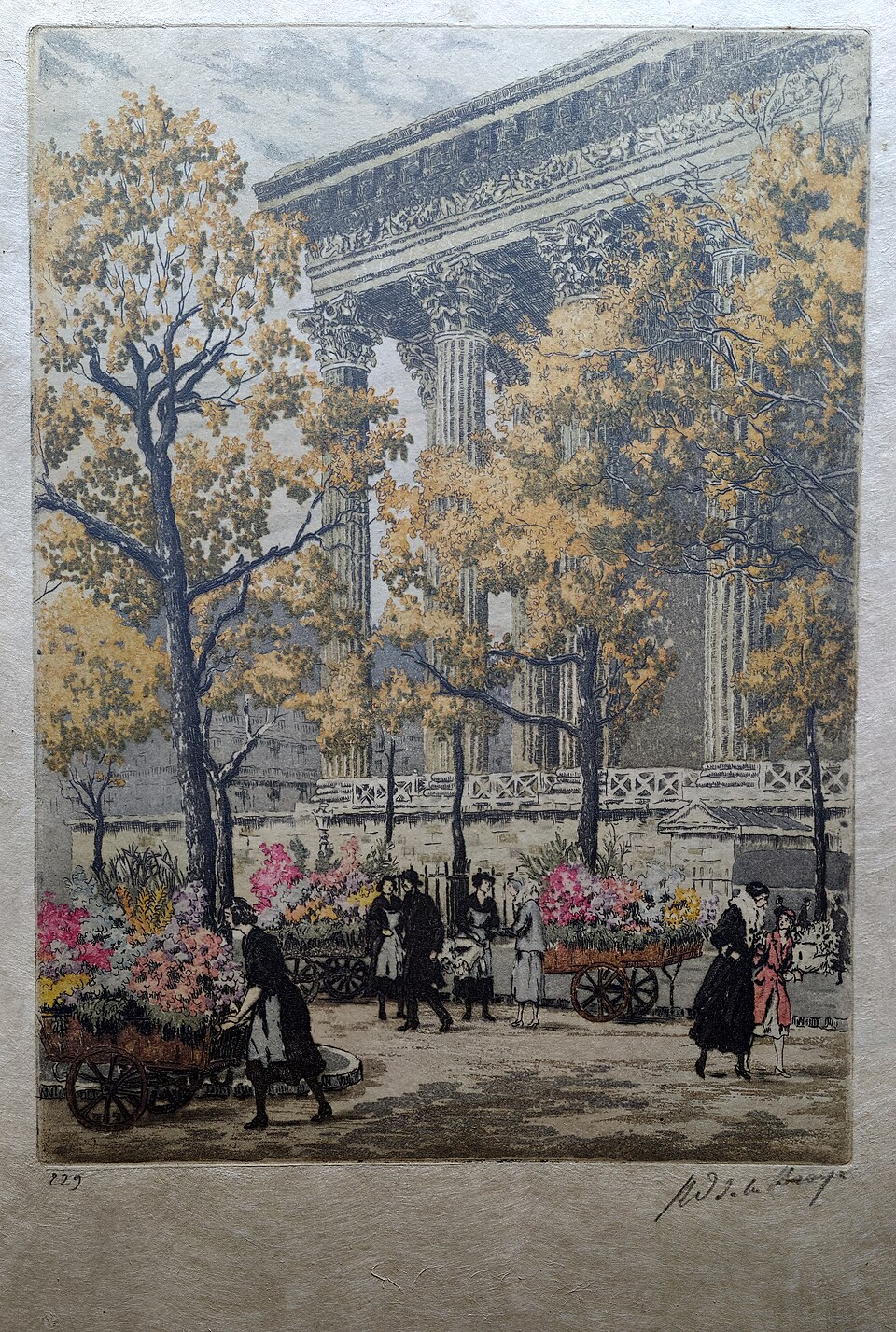
Two different things hang on a wall under the word “print”. One is an artist’s own multiple. The other is a photographic copy of a picture made somewhere else. Listings blur the two, and the price gap between them is wide. This page gives you the definitions museums use, then a few checks you can run with a torch and a cheap loupe. It belongs to the originals and prints section; for what to pay and where to look, go on to the buying guide.
Ask who made the plate
Every check below is a way of testing the answer when a seller will not give one.
An original painting is the easy case. Pigment, whether oil, acrylic, gouache or watercolour, applied to a surface by hand. A print is wider: Tate defines it as an impression made by any method involving transfer from one surface to another. That covers a woodcut and a supermarket poster alike, which is why the word needs a qualifier.
An original print is the artist’s own work in another medium. Britannica’s survey of printmaking treats fine prints as original works of art, even though they exist in multiples. Each impression counts as an original, and is called an impression, not a copy. Typically the artist made the image on a metal, wood, stone or stencil matrix, then inked it and pressed it to paper, personally or through an atelier.
A reproduction is a different object. A print that copies another work, especially a painting, is a reproductive print, a derivative, multipliable replica. The trouble is that reproductions are sometimes promoted in terms similar to those used for original prints, and editions of original prints are often confused with reproduction prints.
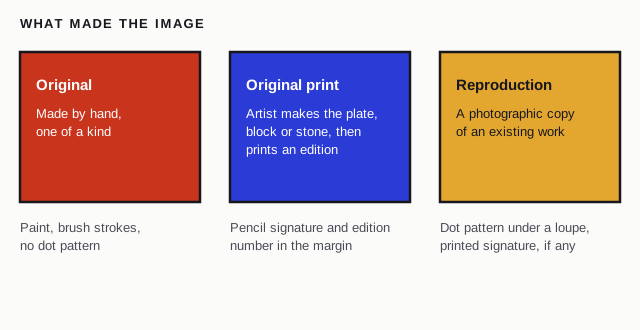
One label to watch is giclée. It names a printing method, not a verdict: it can describe an artist’s own limited edition or an open-edition copy, and the word alone does not say which. The giclée guide covers the process and the cost.
Six checks you can run at home
These come from appraisers, not a laboratory. Use several together, because no single sign settles it: reproductions and original prints can both be signed and numbered.
Swipe the table sideways to see every column.
| Check | What an original shows | What a reproduction shows |
|---|---|---|
| Surface texture | Brush strokes you can see or feel; paint sits on top of the surface | Ink lies flatter and does not cast the same ridge shadows |
| Magnification | Continuous pigment | A dot pattern, the mark of a photomechanical reproduction |
| Edges | Edges uneven, ragged or running to the edge of the surface | A clean, straight boundary that stops short of the edge suggests a print |
| Plate mark | Intaglio prints show a straight raised lip around the image | A print sold as an etching with no plate mark showing deserves caution |
| Signature | A second, hand-rendered signature, usually in the margin | A signature printed in the plate appears on every print and does not make it a signed print |
| Edition number | Hand numbered, usually in pencil in the margin | A limited edition you cannot see a number on may be a photomechanical copy |
Start with light. Hold a torch at a low angle across the surface, which is raking light, and texture turns into shadow. Paint sits on top of the surface while printed ink usually lies flatter. Real paintings usually have brush strokes you can see or feel, though some artists erase theirs, so a smooth surface does not prove a print. Raised-looking strokes that feel flat are a red flag. A giclée on canvas has a completely uniform texture, with none of the swirls, skips or build-ups of real paint.
Then magnify. A 10x loupe and a flashlight answer the question in about 10 minutes. Dots mean print and continuous pigment means paint. A uniform colour field that resolves into dots is a red flag.
The hard case is the hand-finished giclée. Some artists print giclées of their own originals, then embellish, sign and number them by hand, which makes them harder to tell from paintings. Large areas that were printed rather than painted should still show.
The print methods you will meet
When a listing names the method, you know what to look for. Five methods cover most of what you will meet.
- Woodcut: the block is carved so the image stands out in relief, then inked and pressed to paper, so the raised surface carries the ink.
- Etching: the plate is immersed in acid and the exposed metal is “bitten”, producing incised lines, and ink is left in the sunken lines. The plate is pressed against the paper under great pressure, which is why you see a plate mark.
- Drypoint: a design drawn on a plate with a sharp needle-like tool. The burr gives a velvety line, and the edition is usually small because the burr is crushed in printing.
- Lithograph: a greasy image on a flat stone or plate repels water, and oil-based ink sticks only to the image. It gives smooth tones and a wide range of marks.
- Screenprint: ink forced through a stencilled screen with a rubber squeegee. Artists have used the method since the 1930s in America.
Lithography has a commercial cousin. Offset lithography prints the image onto an intermediate surface before the final sheet, so “lithograph” on a listing needs the same question about who made the plate as any other print word.
Editions, numbers and proofs
An edition is a series of identical impressions made from the same printing surface. Before the late nineteenth century prints were often produced in as many numbers as the process allowed, and since then the number has usually been restricted and declared as a limited edition. A modern artist’s print run is fixed in advance and can be as small as 2 or as large as 1000 or more.
The limit is sometimes set by the process, because the plate wears out, and more commonly by the artist or publisher, who then usually destroys the printing surface. Etching plates wear very rapidly, so later impressions are inferior, and a multiple is the term for a deliberately unlimited run.
Most modern artists produce limited editions, signed in pencil and numbered, say 67/100, to show the number of that impression and the size of the edition. Proofs sit outside the numbers: AP marks an artist’s proof and PP a printer’s proof. A hand-numbered 54/150 means the 54th print in a run of 150. Be wary of big runs: an appraiser flags runs over about 250 as a possible sign of a photomechanical process.
Do not let a signature or a number reassure you too far. Both reproductions and original prints can be signed and numbered by the artist, so a signature alone does not verify that a piece is original. A reproduction can be sold as a “limited edition” with investment potential, a promise that is rarely realised, and even signed and numbered ones are still reproductions. A signed and numbered reproduction is limited only by an arbitrary choice of the artist, because infinite numbers of prints could be produced. An autograph on a poster can raise its value but does not make it a fine art print. Editions produced after an artist’s death by an estate are usually far less sought after.
What to ask a seller
Ask four questions, in this order. Who made the plate, block, stone or screen? Were the signature and the edition number written by hand, in pencil, in the margin? How big is the edition, and do any proofs sit outside it? If the piece is a giclée, did the artist print it from their own original?
If the seller cannot answer, or only says “limited”, treat the piece as a reproduction until shown otherwise.
What you can expect to pay
Price follows the order of the objects. All other things being equal, original painted works appraise higher than limited edition prints, and limited edition prints appraise higher than open edition reproductions such as posters. Prints can give much of the look of a painting at a fraction of the cost. Original prints are the exception to the rule that prints are worth less, and a signed lithograph, etching or screenprint can be valuable.
Open edition runs are large and may stop after a few years. A multiple is a series of identical artworks, effectively unlimited, made to be sold cheaply. If you are buying from someone at the start of their career, the guide to buying from emerging artists covers what an invoice should say. If the work is on paper, how to frame art comes next.
Questions readers ask
How can you tell if art is original or print?
Look under a 10x loupe with a torch held low across the surface: paint shows brush strokes and continuous pigment, print shows a dot pattern and flatter ink. Then check the margin for a pencil signature and an edition number such as 12/50.
Is a signed and numbered print an original?
Not always. Both reproductions and original prints can be signed and numbered by the artist, and a reproduction called a limited edition is limited only by the artist's choice. What decides it is whether the artist made the plate, block or stone.
What is the difference between an original print and a reproduction?
An original print is an impression the artist made from a plate, block, stone or screen, and each impression counts as an original. A print that copies another work, especially a painting, is a reproductive print.
Read next
- 05
Buying art from emerging artists: where to find them, what to ask and what to check
How to buy from artists early in their careers: where to find them, how to visit a studio, what an invoice should list and what prices to expect.
- 05
Where to buy affordable art: degree shows, open studios, fairs and museum galleries
Where to find original art that costs less than a gallery: degree shows, open studios, price-capped fairs, museum rental galleries and interest-free credit.
Sources
- Printmaking · Wikipedia · en.wikipedia.org · checked 21 October 2026
- Printmaking (Introduction) · Encyclopaedia Britannica (via Wayback) · britannica.com · checked 21 October 2026
- Edition (printmaking) · Wikipedia · en.wikipedia.org · checked 21 October 2026
- Original art vs prints: eight top tips for telling a print from a painting · WorthWise Appraisers · worthwiseappraisers.com · checked 21 October 2026
- How to tell if a painting is original or a print · Appraisily · appraisily.com · checked 21 October 2026
- Edition · Tate · tate.org.uk · checked 21 October 2026
- What's the difference between an original print and a reproduction · Seaside Art · seasideart.com · checked 21 October 2026
- Is it an original or reproduction print · Gallery 78 · gallery78.com · checked 21 October 2026
- Print · Tate · tate.org.uk · checked 21 October 2026
- How to tell a proper print · The Christian Science Monitor · csmonitor.com · checked 21 October 2026
- Giclée · Wikipedia · en.wikipedia.org · checked 21 October 2026
- Multiple · Tate · tate.org.uk · checked 21 October 2026
- Lithography · Tate · tate.org.uk · checked 21 October 2026
- Screenprint · Tate · tate.org.uk · checked 21 October 2026
- Etching · Tate · tate.org.uk · checked 21 October 2026
- Drypoint · Tate · tate.org.uk · checked 21 October 2026
- Woodcut · Tate · tate.org.uk · checked 21 October 2026
- Differences between painting and print · Fine Art Pub · fineart.pub · checked 21 October 2026
Published . Prices, duty rates and rules change: each source shows the day it was checked. How we check facts · Report an error.