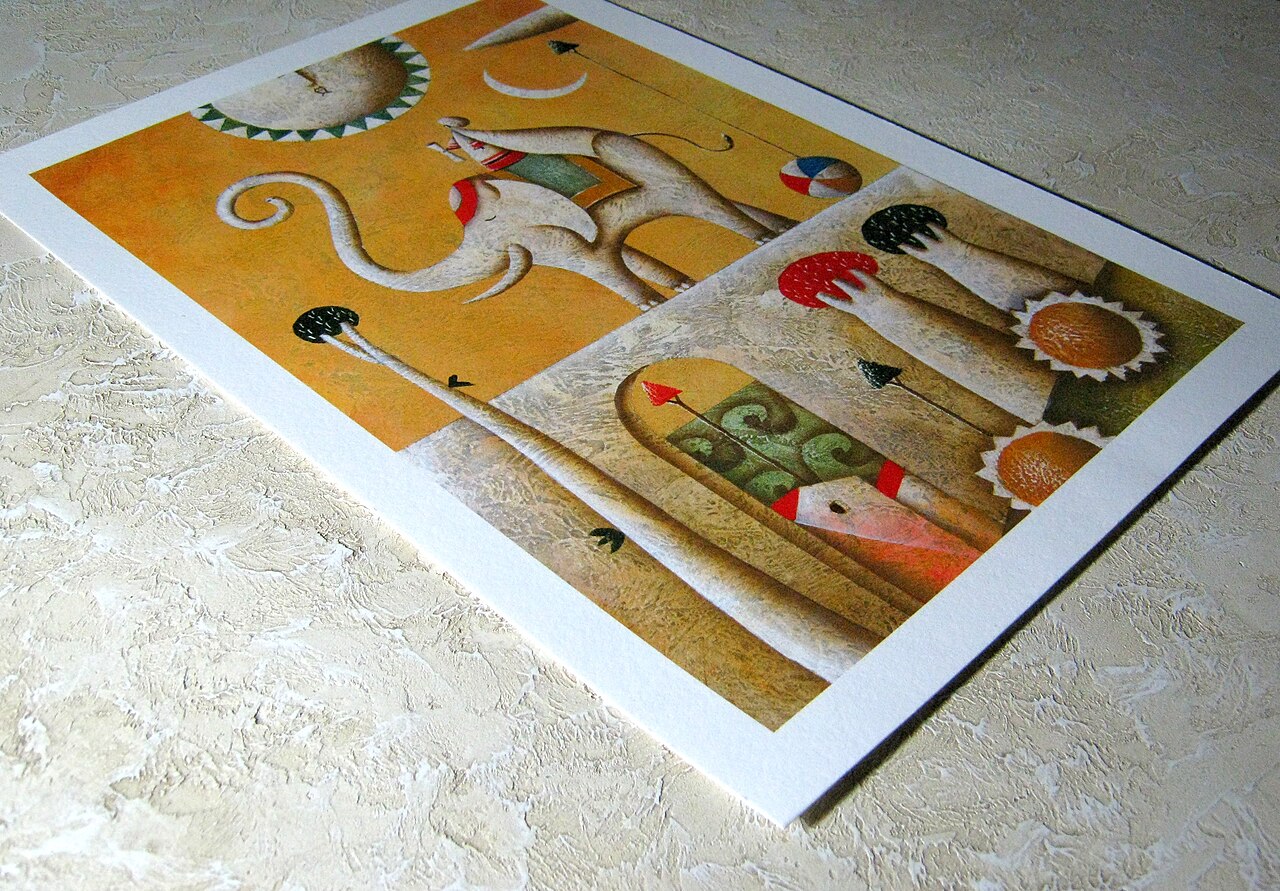
Giclée began as a printer’s word and ended up on every second online listing. It now covers anything from a carefully proofed archival print to a cheap poster with a French name. The word alone tells you almost nothing, so this page is about the three things that do: the ink, the paper and the edition. It sits in the originals and prints section, next to the guide to original art vs prints.
A word invented to sell prints
Printmaker Jack Duganne coined it in 1991, from the French gicleur, a jet or nozzle. He worked at Nash Editions and wanted a name that set the new prints apart from the commercial Iris prints then used as proofs. Those came from a modified Iris printer, a process invented in the late 1980s.
Graham Nash was the customer who turned it into a business. He bought his own Iris printer for $126,000 and set up a digital reproduction company on it. Early problems included heavy paper stock and inks that faded poorly. By the 2010s Epson and other large-format printers, much cheaper and using inks designed to be archival, had mostly replaced the Iris.
Today giclée means any fine-art printing, usually archival, done by inkjet. In looser use it is stuck on art prints of every quality. The French term sets no technical criteria and gives no assurance of quality, which is why “archival digital pigment prints” is the more exact label.
Ink decides how long it lasts
Dye inks are cheap and can look spectacular, but they fade. Most dye-based inks fade rapidly when exposed to light or ozone. Pigment-based inks cost more and give much better long-term durability and ultraviolet resistance, and inks sold as “archival quality” are usually pigment-based. That is why professionals generally prefer pigment for fine-art work.
Both kinds of ink age. Dye prints fade from light and from oxidation, the chemical change that is now the commonest cause of colour shift in inkjet prints and the one pigment printers rarely suffer. Pigment resists both better, but better is not immune: inkjet remains the least stable family of digital print and needs the most care.
Ink count matters for colour too: a current giclée printer has 10 to 12 inks including special colours, and more inks give a wider range of colour and smoother gradients.
Paper and canvas
A good giclée needs a surface made for the job: matte photo paper, watercolour paper, cotton canvas, pre-coated canvas or textured vinyl. Archival paper is permanent and acid-free, made to last. It does not have to be cotton, which is a common misconception. Archival papers should meet standards, ISO 11108 internationally and ANSI standards in the US, and paper that misses them can degrade or react with the ink in unpredictable ways. Paper and coating also change how pigment inks behave and last.
How a giclée differs from a poster
A standard print is any mechanically reproduced image, often made fast and in high volumes with basic commercial printing. A giclée is made on a wide-format inkjet printer, not a desktop one, from a file of at least 300 DPI. Not every inkjet print counts: a digital print of an art piece is not automatically a giclée.
It is also a reproduction. It is not classed as an original one-off but as a high-quality reproduction, and artists mostly use inkjet to reproduce their own two-dimensional work, photographs or computer-generated art. How that differs from a painting, or from an original etching or lithograph, is in original art vs prints.
There is one tell on the surface. Giclées are known for colour and detail, not for texture, although hand finishing can mimic brush strokes.
Open or limited
Artists choose between open and limited editions. In an open edition the artist reserves the right to make more. In a limited edition the number made is declared, and the prints are usually signed and numbered. Limited giclée editions can run from 10 to 150 copies, sometimes with a certificate of authenticity. The Govilon edition above is much larger, so check the declared number rather than assuming a limited run is small. Since the late nineteenth century the size of a print edition has usually been restricted and declared. A signature or edition number can give a print a collectible feel, but it does not turn a reproduction into an original.
What one costs
Price follows the artist, the size and the edition, not the word. Three dated UK listings show the spread. Govilon’s community website sells numbered giclées on archival pigment ink and acid-free watercolour paper at £12 for A4 (edition of 450), £25 for A3 (250) and £55 for A2 (100). Broadway Gallery in Letchworth offered a Somerset-paper pigment giclée, an edition of 20 plus two artist’s proofs, at £220 unframed in January 2022. Underneath both sits the printing bill: theprintspace, a London print lab, lists A3 at £13.11 and A2 at £25.32 as its base price. The smaller the edition, the more each print tends to cost. Use these for scale and compare two or three artists before you pay.
Behind the price sit real costs. The printers are large-format machines, pigment inks cost more than dye, and archival paper adds more. The upside is that inkjet needs no plate set-up, so an artist can print and sell on demand and control colour correction and the surface personally. For buyers, lower prices let more people collect an artist’s work.
The limited editions guide explains what the numbers mean, and how art is priced shows why an original costs far more.
Is it worth buying?
That depends on what you want from it. A giclée is a way to own an image you like for less than the original costs. It is not a one-off, so the price should say so. Check three things before paying: the ink is pigment, the paper is archival, and the edition is declared. If a seller will not answer all three, walk away. And ignore any promise about future value: this page gives no investment advice.
Glass, light and storage
Framing behind glass or acrylic helps protect a giclée from moisture, dust and touch, and sunlight can degrade the inks and fade the colour.
Should you put glass over it? In most cases, yes. Frame it behind glazing that filters ultraviolet light. Ordinary clear glass is not a UV filter: it transmits over 90% of visible light and cuts out only UV below 300 nanometres. Filtering UV helps, but visible light harms paper too.
Glass or acrylic? On the CCI glazing note, glass resists scratching better than many plastics, while acrylic is lighter and safer to handle but scratches more easily and can bow when large. Either way, keep the print off the glazing: damp that condenses behind glass can move onto the paper. Frame materials should all be chemically stable; the how to frame art guide covers mats and spacing.
Digitally printed art is vulnerable to touch. Even light friction or a tiny drop of water can damage some inkjet prints. Handle with gloves, use polyester enclosures, mount with window mats, use UV glass and check exhibited prints closely. Keep pigment-ink prints on their matching paper in the dark, at room temperature and 30-50% relative humidity, for the best stability.
Avoid basements and attics, where temperature and humidity fluctuate. Hang away from windows and skylights, spotlights, radiators and heating ducts. High humidity for long periods raises the rate of chemical degradation and the risk of mould. When a print is not on the wall, store it in a neutral pH box.
Skip the fixative spray. A well-designed sealed frame is the better protection, because you never really know how a fixative will age. Once ink has faded it cannot be restored, so keep the light off it from the start. If you are unsure how to get the finished piece onto the wall, how to hang art goes through the fixings.
Short answers
- What is the difference between a giclée and a print?
- A giclée is one kind of print: a digital print intended as fine art, made on an inkjet printer. A standard print is any mechanically reproduced image, often basic commercial printing in high volumes. The word alone promises no quality standard.
- Are giclée prints worth it?
- As reproductions, not one-off originals. They let an artist offer work at a lower price point, and a limited edition tells you how many exist. Judge each one on its ink, paper and edition, since the label guarantees none of them.
- Do you put glass over a giclée print?
- Yes, framing behind glass or acrylic protects it from moisture, dust and touch. Choose UV-filtering glazing, keep a gap between print and glazing, and still keep it out of sunlight, because all light damages paper.
- Why are giclée prints so expensive?
- The equipment and materials cost more: large-format inkjet printers, pigment inks that cost more than dye, and archival paper. A large-format inkjet print can cost more than ten times an offset litho print in a run of 1,000, which is a cost for the printer, not a price for you.
Sources
- Giclée · Wikipedia · en.wikipedia.org · checked 21 October 2026
- What is a Giclée Print? (& Why They're Worth It) · Brooklyn Editions · brooklyneditions.com · checked 21 October 2026
- Inkjet printing · Wikipedia · en.wikipedia.org · checked 21 October 2026
- Paper collections FAQ (preservation) · Library of Congress · loc.gov · checked 21 October 2026
- Basic care: works of art on paper · Canadian Conservation Institute · canada.ca · checked 21 October 2026
- What is a Giclée Print? All You Need to Know · Printful · printful.com · checked 21 October 2026
- What Is a Giclee Print? · Native Visions Gallery · nativevisions.com · checked 21 October 2026
- Glazing Materials for Framing Works on Paper (CCI Notes 11/3) · Canadian Conservation Institute · canada.ca · checked 21 October 2026
- Iris printer · Wikipedia · en.wikipedia.org · checked 21 October 2026
- Print longevity · Photo Review · photoreview.com.au · checked 21 October 2026
- Identification and Preservation of Digital Prints workshop · The Preservation Lab, University of Cincinnati Libraries · libapps.libraries.uc.edu · checked 21 October 2026
- Edition · Tate · tate.org.uk · checked 21 October 2026
- Preservation Guidelines for Matting and Framing · Library of Congress · loc.gov · checked 21 October 2026
- Conservation DistList 2003: inkjet prints · Conservation DistList · cool.culturalheritage.org · checked 21 October 2026
- Limited Edition Prints: price list · Govilon Village (community website) · govilon.com · checked 21 October 2026
- Understanding prints and editions · MyArtBroker · myartbroker.com · checked 21 October 2026
- Freya Pocklington - Prints (28 Jan 2022) · Broadway Gallery, Letchworth · broadway-gallery.com · checked 21 October 2026
- Art print prices: giclée prices · theprintspace (London print lab) · theprintspace.co.uk · checked 21 October 2026
Published . Prices, duty rates and rules change: each source shows the day it was checked. How we check facts · Report an error.