A price on a wall label ends a string of decisions: who made the work, what it is made of, how many exist, who sold it and what similar pieces fetched. If you only do one thing before you buy, compare the price with sold prices for similar work, not asking prices. The rest of this page explains why that works, how artists reach their numbers, and where a gallery’s cut goes. It opens the pricing section. Figures carry the currency of their source, and none of it promises that a work will rise in value.
What moves a price
No single formula decides it. Galleries weigh several factors together, from an artist’s career to the individual work. Career comes first. An emerging artist with a limited sales history sits in a different range from one with years of exhibitions and institutional recognition, and recent solo exhibitions or awards can justify higher prices. Size and medium follow: oil paintings on canvas typically fetch higher prices than works on paper. Scarcity matters, and a smaller edition generally creates more of it. So does condition, because physical condition and the extent of restoration both count in valuing art.
Bigger does not always mean dearer. A smaller work that matters to an artist’s practice may command more than a larger, less significant piece. Two artists can use the same size and materials and still sit at very different price points, because careers, demand and exhibition histories differ. Less tangible things play in as well, such as how much the buyer trusts the seller and how badly the seller needs the money.
How artists do the sums
Most artists start from a formula and then adjust. Formulas are starting points, not strict rules. There are three common ones. The first is (hourly wage × hours spent) + cost of materials, a first pricing structure. The second is height × width × price per square inch, commonly used for paintings, drawings and prints. The third, (height + width) × price per linear inch, gives a more consistent relationship between differently sized works.
Time and materials
Time alone does not determine value. If an experienced artist makes a work quickly, it is not automatically priced lower. Small, intricate originals typically cost more per centimetre than larger editioned screenprints, because they take longer to make. Artists often double their material costs to cover expenses.
Saatchi Art’s help page gives a worked example: materials of $50, $20 an hour and 20 hours come to ($50 x 2) + ($20 x 20) = $500. The painter Stephanie Scott runs the same method on a 3x5 foot canvas: 32 hours at $11 an hour is $352, plus materials makes $572, and 20% on top gives $686.40. The materials alone cost $220, and the painting sold for $275, which left about $1.75 an hour for her time. A formula gives you an asking figure, and an early-career price follows the market rather than the maths. Treat it as one artist’s method, not a price list.
Where a gallery’s cut goes
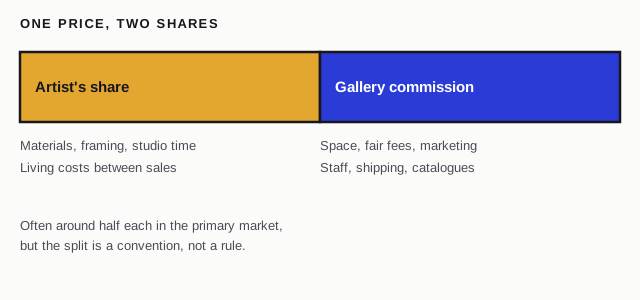
Galleries usually take a commission, often around 50% of the sale price. A roughly 50/50 split is common in the primary market, but it is a convention rather than a fixed rule. Non-profit or cooperative spaces often follow a 40/60 split favouring the artist. The commission pays for studio visits, fairs, shipping, photography, catalogues and marketing. One online marketplace takes 40% on originals and calls 50% the standard gallery rate, so the figure depends on the seller. Consistent prices across channels protect an artist’s market and a gallery’s credibility.
Unique works, editions and prints
An editioned work can be sold several times and normally costs less than a unique one. In printmaking, an edition means a set of prints pulled from a single plate. Tate’s glossary defines the limit: modern artists’ prints run from 2 to 1000 or more. The lower the second number in a pair such as 14/100, the more collectable the edition is likely to be, though the numbering may not match the order printed.
Tate prices its Limited Editions in batches, each dearer than the last as the edition sells out. Be wary of a reproduction sold as a limited edition with investment potential, which rarely realises it. The reading rule for all of this is in original art vs prints, and framing is an extra cost, covered in how to frame art.
First sale, resale and the auction estimate
The primary market is where new art comes to market for the first time, and the secondary market is for art sold at least once before. Primary-market prices have a direct bearing on secondary value. On resale, auction results, provenance, rarity, condition and demand can all influence value. Auction estimates are given as ranges to offset uncertainty, and they often reflect the consignor’s ambitions as much as the specialist’s opinion. For an unknown artist with no auction history, the risk of an incorrect valuation is greatest.
Judging a price as a buyer
Start with sold prices of similar work, not asking prices. Check how fresh the comparisons are, because stale comparables give estimates with little relation to current value. Ask a gallery why similar pieces differ: consistency means being able to explain the difference. Check condition, which online sale-history databases generally leave out. And read price lists with care, because a dealer may sell for much less than list, particularly after an item has sat unsold for a long time.
As a rough US scale in dollars, a good-sized painting should typically not sell for less than $3000, works on paper by an unknown artist sit in the $500 to $1000 range, and a limited edition print should not be over $200 to $500 unframed. That is a US scale from one dealer-side source, not a UK price table. For pounds, the dated UK price points are on where to buy affordable art and what is a giclée print.
A discount is likelier if the artist is not selling well, you may become a repeat client, or the piece has sat in inventory. A dealer cannot discount a consigned work. For lower-priced routes, see where to buy affordable art.
What prices look like in pounds
The affordable end of UK pricing, from fair stands to graduate shows, is laid out in where to buy affordable art. Here it is enough to know where galleries expect a first original to sit: Own Art, the UK interest-free credit scheme, offers standard finance from £250 to £5,000 through participating galleries, and up to £25,000 at some.
How the value of art is worked out
Valuation compares data from auction houses, collectors, dealers, gallerists and analysts. The Art Dealers Association of America names authenticity, quality, rarity, condition, provenance and value as the key issues. For new artists, one method looks at scale, intensity and medium. In United States tax rules, fair market value is the price agreed between a willing buyer and a willing seller, with neither required to act and both having reasonable knowledge of the facts. Under Internal Revenue Service guidance, donated art claimed above $5,000 needs a qualified appraisal, and art appraised at $50,000 or more can get an IRS Statement of Value. That is a United States tax rule, but the willing-buyer idea is a useful anchor anywhere.
Short answers
- How do artists price their art?
- Most combine the cost of materials, time and a market check. Common formulas are (hourly wage × hours) + materials and height × width × a rate per square inch. Artists then adjust for career stage, exhibitions and what comparable artists charge.
- How do I calculate the price of my art?
- Work out (hourly wage × hours) + materials, or height × width × a price per square inch, then test the result against comparable artists. Treat the formulas as starting points, not strict rules. Add gallery commission if you sell through one.
- How do you determine the value of art?
- Compare recent sales of similar work, and weigh authenticity, quality, rarity, condition, provenance and value. Fresh comparables matter, because stale ones give estimates with little relation to current value. In US tax rules, fair market value is the price a willing buyer and a willing seller would agree.
Sources
- How to price art: a guide for galleries · Artlogic · artlogic.net · checked 21 October 2026
- How to Price Your Art · ArtConnect Magazine · magazine.artconnect.com · checked 21 October 2026
- Understanding Art Pricing: How are art prices calculated? · Affordable Art Fair · affordableartfair.com · checked 21 October 2026
- Edition · Tate · tate.org.uk · checked 21 October 2026
- The Best Way To Price Your Art · Stephanie Scott · stephaniescott.art · checked 21 October 2026
- Art valuation · Wikipedia · en.wikipedia.org · checked 21 October 2026
- Publication 561: Determining the Value of Donated Property · Internal Revenue Service (US) · irs.gov · checked 21 October 2026
- What is Art Worth? (The Collector series) · Kathryn Markel Fine Arts · markelfinearts.com · checked 21 October 2026
- How to Price Your Artwork (via Wayback) · Saatchi Art Help Center · support.saatchiart.com · checked 21 October 2026
- Edition (printmaking) · Wikipedia · en.wikipedia.org · checked 21 October 2026
- Limited Editions buying guide · Tate Shop · shop.tate.org.uk · checked 21 October 2026
- Own Art: FAQs · Own Art (Creative United) · ownart.org.uk · checked 21 October 2026
- Art market · Wikipedia · en.wikipedia.org · checked 21 October 2026
Published . Prices, duty rates and rules change: each source shows the day it was checked. How we check facts · Report an error.