On this page
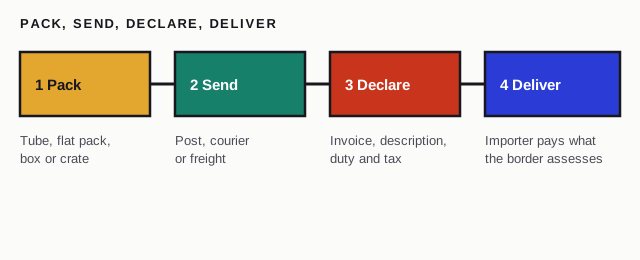
A painting that crosses a border has to survive two journeys: the physical one, and the paperwork one. Damage usually comes from packing and customs trouble from the declaration.
This guide starts with what a buyer in Great Britain pays and who collects it, then covers packing, the documents customs wants and what the United States and Canada say about duty and tax on art. It also covers sending art out of the UK. It opens the shipping and customs section.
Buying from abroad into Great Britain: what you pay
The sums are small on art, because duty is nil and VAT is charged on a reduced value. Three charges can apply, and each has its own source.
Swipe the table sideways to see every column.
| Charge | What applies to a painting | Who collects |
|---|---|---|
| Customs duty | Third country duty of 0.00% on heading 9701910000, paintings, drawing and pastels | Nil on paintings, so there is nothing to collect |
| Import VAT | Works of art are taxed on a reduced value at importation, giving an effective VAT rate of 5 per cent | Goods worth more than £135: you pay VAT to the delivery company before delivery or when you collect |
| Carrier handling fee | £8 on Royal Mail products, £12 on Parcelforce products, and £25 where goods are valued over £900 | Royal Mail pays HMRC the import VAT and duty on your behalf, then sends you a fee to pay |
To work out the VAT, take the value for duty, add any additional costs, multiply by 25% and apply the 20% rate. VAT is charged on the total package value, including the goods, postage, packaging, insurance and any duty. Here is that method for a typical affordable original, with £60 of postage added because postage counts toward the value, and a Royal Mail handling fee:
Painting price                 £400
Postage and insurance           £60
Total package value            £460
Reduced value (x 25%)          £115
Import VAT (20% of reduced)     £23
Customs duty (heading 9701)      £0
Royal Mail handling fee          £8
Due before delivery             £31
With free postage the same painting would come to £28 (£100 reduced value, £20 VAT, £8 fee). Postage is the line buyers forget.
The rates are from the sources above, read on the date shown in the Sources list, and the arithmetic is ours. A courier other than Royal Mail sets its own handling fee, so ask the seller which carrier they use and what that carrier charges the recipient. If the bill is not paid, HMRC normally holds a parcel for about 3 weeks and then returns it to the sender. Only works defined in section 21 of the VAT Act qualify for the reduced valuation.
What to ask the artist before you pay
You do not pack the work, so settle these in writing before you send money:
- The packing: a tube for unframed work or a rigid box for framed work, using the methods below.
- A tracked and insured service, since the guidance for art shippers is to use a fully traceable and insured method.
- The carrier, so that you know who will contact you for VAT and any handling fee.
- A declared value that matches the invoice. Giving misleading information about an item or its value is illegal in the United States, and many offers to understate the price to save duty are illegal too.
- Photographs of the work packed, before it leaves.
- What happens if it arrives damaged or does not arrive, and who is responsible.
On arrival, check the parcel against the invoice, and if it looks damaged note it on the waybill, take photos, unwrap at once and keep the wrapping. For safe ways to pay an artist abroad and what to do if the work never arrives, see buying art from emerging artists.
What international art shipping costs
Fees depend on size, weight, packaging, distance and insurance. Artists often forget declaration fees and handling surcharges. Three routes exist, and each trades cost against size and care.
A postal service is cost-effective and often much cheaper for smaller works, but with maximum size limits. A courier is reliable, but expensive for large or heavy works. For bigger consignments, brokers can sometimes find better rates, and freight can be affordable if objects are extremely well packed and crated.
Quotes for the same parcel vary wildly, so ask several carriers. Cut-rate shipping often needs better packing. Check size rules before choosing a tube: Canada Post applies a surcharge to cylindrical mailing tubes, except on its Small Packet and Tracked Packet services. On freight, ask for a non-cubed weight measurement so the charge is not rounded up.
Packing by format
Rolled canvas and paper
Unframed art is generally cheaper and less risky to send because it can be rolled in a tube. Check first that the work can be rolled at all: the paint must be flexible enough to withstand rolling without cracking and firm enough, not tacky. Roll a painting with the paint side out. Conservators say paintings should always be rolled face outwards with a protective interleaving sheet over the paint, around a solid tube with as large a diameter as possible. The tube diameter should be no smaller than 12 inches, and larger is better. Rolling with the painted side on the inside compresses the paint, which can crack, flake or separate.
Do not use plastic sheet against the paint: plastic wraps contain plasticizers that, over time, may migrate into acrylic and oil paint films. Use acid-free glassine as the interleaf and pad the ends of the tube. A tube more than 2mm thick is advised for lower-value prints. For a valuable, old or heavily built-up painting, ask a conservator or fine-art shipper before rolling.
Flat work
Higher-value prints and works on paper travel better flat. Sandwich an unframed work on paper between two sheets of cardboard slightly larger than the work and wrap it in plastic. A flat unframed painting goes in glassine then plastic, with all seams taped. For raised paint, build a cardboard collar 8 to 10 inches larger than the work in both dimensions.
Framed work
Framed work needs a stiff outer layer. Place it between plywood sheets or thick foam boards, then in a double-walled box that fits snugly, labelled fragile and “This Side Up”. Leave 1 to 2 inches of space on each side inside a box or crate. See how to frame art for glazing choices.
Glass is the weak point, and the sourced answer on tape is specific. Low-tack tape belongs among the wrapping materials for glass glazing: tape the outside of non-laminated glass fully with strips of low-tack protective tape, so that if the glass breaks the tape may hold shards in place. The caveat is that tests found damage to a painting was often similar whether the glass was taped or not. Take the tape off gently and soon after travel, to avoid damaging the glass surface treatment or coating. Glass may carry a special non-glare coating, so avoid excessive tape and make tabs for easy removal. In practice: low-tack tape only, no packaging or masking tape on the glass, and for a painting larger than 1 m2 consider laminated anti-reflective glass or acrylic. Keep bubble wrap off the work itself, because it can leave marks on all but glassy surfaces, and never use staples.
When to crate
Crates should always be used for longer transits. A crate is a carefully constructed wooden container with a cushioned interior, not just a plywood box. Skids built into the base support the work. Museums line wooden crates with thick rigid foam and corrugated plastic, because the most likely damage is a forklift puncturing the outside. Framed works sit face to face and back to back with a sheet of corrugated plastic between each. Label the crate with contact details, crate number, fragile signage and orientation.
Avoid local household packers, who are not experienced in protecting fine art. Do not advertise the contents on exterior labels.
Sending art out of the UK
Shipping from Great Britain to a buyer abroad has three steps: the customs declaration on the parcel, a licence check for cultural objects, and the rules in the buyer’s country.
Customs declaration first. Every gift or item of goods sent abroad needs a customs declaration, a CN22 or CN23. A parcel sent without one, or with a form filled in incorrectly or only partly, may be delayed or returned to sender. A CN23 is typically used for items valued over £270 but can be used for items of any value. Royal Mail’s help page is written for its own services, so a courier will ask for the same facts (what it is, its value, where it was made) in its own booking form.
Then the export licence. A UK export licence is required to export cultural objects from Great Britain to any destination outside the UK, and the system is run by Arts Council England. A new work sold by a living artist is not what that system is aimed at, but whether a particular work counts is a question for the Arts Council, not for the seller. If the work is old or valuable, email enquiries@artscouncil.org.uk before it ships: anyone in doubt about whether they need a licence is advised to contact the Arts Council.
Last, the buyer’s side. The country you send to sets its own import rules. Check that whoever you are sending to is able to import the goods into their country; the recipient may need to make an import declaration there. The country sections further down cover Great Britain, the United States and Canada. For anywhere else, ask the buyer to check with their customs authority before you ship, and pass on the declared value you put on the form.
Customs declaration forms and invoices
Declare the work accurately. In the United States, a shipment needs a customs declaration form attached to the outside, with a full and accurate description of the merchandise. The description must be in English, a legal requirement, and it determines the classification number and duty rate. The form also needs the purchase price in dollars and the country of origin, which is not necessarily the country where the item was bought. In the United States, a foreign shipment without a declaration and an invoice may be seized, forfeited or returned to sender.
For original prints, U.S. rules add a requirement: invoices claiming duty-free entry must show whether the works are originals, replicas, reproductions or copies, and name the artist. The port director may waive the extra declaration. The original art vs prints guide explains why that distinction matters.
Duties and taxes by country
The importer is liable, not the seller. In the United States, CBP holds the importer liable for duty, and when you buy goods from a foreign source you become the importer. A purchase price that includes shipping does not mean clearance costs are covered, because broker fees and CBP duties may be extra.
Rates and thresholds change. Each country below gives what the cited government page said when read; the read date sits in the Sources list.
Great Britain
VAT is charged on all goods except gifts worth £39 or less sent to Great Britain from outside the UK. For goods worth more than £135 you pay VAT to the delivery company before delivery or collection. Works of art qualify for a reduced import valuation, which involves multiplying the total by 25%, and applying the 20% rate gives an effective VAT rate of 5%. The classification matters: heading 9701 covers paintings and drawings created entirely by hand, and heading 9702 covers original engravings, prints and lithographs produced in limited numbers and excluding those made by mechanical or photomechanical processes. A reproduction does not qualify. HMRC normally holds a parcel for about 3 weeks, then returns it to the sender if the tax bill is unpaid.
United States
Original works of art must be declared, but most paintings enter duty-free under heading 9701. Paintings, drawings and pastels executed entirely by hand carry the general rate Free in the Harmonized Tariff Schedule, Revision 21, 2026, while hand-painted manufactured articles are dutiable at the manufactured article’s rate. A frame of a normal kind and value is classified with the painting, while a frame not normal for the work may be classified separately and may be subject to different rates of duty. Under CBP’s e-commerce guidance, the suspension of the $800 duty-free exemption applies to all modes, including post. Informal entry is generally allowed at $2,500 or less, and formal entry is required above that. A mailed item above $2,500 may be held until a formal entry is arranged. CBP’s 2006 publication records that temporary trade sanctions or restrictions may apply to products of some countries; check the current position for the country where the work was made.
Canada
The 2026 Canadian tariff lists originals by artists as Free, with a 5.5% most-favoured-nation rate on one residual “Other” painting line. Items mailed to Canada may be subject to GST or duty, and the Canada Border Services Agency works out duty on the value in Canadian funds. Mail worth CAN$20 or less carries no duty or tax. Above that, duty, GST or HST and any provincial tax apply on the full value. In the CBSA’s tariff for works of art, a frame of a normal kind and value is classified with the artwork.
Insurance and receiving the work
Use a fully traceable and insured method. Keep an independent valuation or gallery certificate to back up the declared worth, and arrange cover beyond standard courier policies. See how art is priced for how a value is reached.
When the parcel arrives, check it against an inventory list. If it looks damaged, note it on the waybill, take photos, unwrap immediately and keep the wrapping. Collect promptly: in the United States, goods not claimed within 15 days of arrival go to a warehouse with storage charges.
Common questions
What is the best way to ship art internationally?
Match the method to the work. Roll unframed canvas paint side out around the largest tube you can get, flat-pack higher-value prints and works on paper, and use a crate for particularly valuable, large or fragile pieces. Use a fully traceable and insured service.
Is there import duty on artwork to the UK?
Not on a painting. The UK Trade Tariff lists third country duty of 0.00% for heading 9701910000, paintings, drawing and pastels. Import VAT still applies, at an effective 5% on art after the reduced valuation, and you pay it to the delivery company before delivery when the goods are worth more than £135.
Is there import duty on artwork to the USA?
Most original paintings are entitled to enter the United States duty-free under heading 9701, but they must still be declared to U.S. Customs and Border Protection. A painting must be executed entirely by hand to qualify.
What are the best ways to send paintings overseas?
Roll an unframed canvas paint side out around a large solid tube, wrap an unframed flat painting in glassine then plastic and seal the seams, put framed work between rigid boards in a double-walled box, and crate large or valuable work for longer journeys. Declare the true value and purpose of the shipment.
Who pays customs duty on art bought from abroad?
The buyer, as importer, is liable for duty in the United States, not the seller. In Great Britain, Royal Mail, Parcelforce or the courier contacts you if you need to pay VAT, duty or delivery charges. In Canada, GST and duty apply to mail items worth more than CAN$20.
Read next
Prices and budgets
How art is priced: the factors, the formulas and what a fair price looks like
How artists and galleries set prices: career stage, size, medium, edition, gallery commission and the formulas behind them, plus how a buyer can judge a price.
Framing, hanging and care
How to frame art: mats, glazing, frames and a safe DIY method
How to frame a print, drawing or painting so it lasts: the mat, glazing, backing and frame that museum conservators specify, a DIY method and cheap routes.
Sources
- How to Ship Artwork Internationally (via Wayback) · DHL Express · dhl.com · checked 21 October 2026
- Shipping Art Internationally: Practical Strategies · RedDotBlog (Xanadu Gallery) · reddotblog.com · checked 21 October 2026
- What are the packaging and delivery guidelines? · Artfinder Seller Support · sellers.artfinder.com · checked 21 October 2026
- Works of Art, Collector's Pieces, Antiques, and Other Cultural Property (Informed Compliance Publication, May 2006) · U.S. Customs and Border Protection · cbp.gov · checked 21 October 2026
- Harmonized Tariff Schedule of the United States, Revision 21 (2026), Chapter 97 · U.S. International Trade Commission · hts.usitc.gov · checked 21 October 2026
- E-Commerce Frequently Asked Questions · U.S. Customs and Border Protection · cbp.gov · checked 21 October 2026
- How to value goods for import VAT · GOV.UK (HM Revenue and Customs) · gov.uk · checked 21 October 2026
- Importing by mail or courier: paying duty and/or taxes on imported goods · Canada Border Services Agency · cbsa-asfc.gc.ca · checked 21 October 2026
- Getting Smart About Moving Your Art · Chubb · chubb.com · checked 21 October 2026
- Internet Purchases · U.S. Customs and Border Protection · cbp.gov · checked 21 October 2026
- Tax and customs for goods sent from abroad · GOV.UK (HM Revenue and Customs) · gov.uk · checked 21 October 2026
- Importing by mail or courier: determining duty and taxes owed · Canada Border Services Agency · cbsa-asfc.gc.ca · checked 21 October 2026
- Tip Sheet: Travelling Exhibition: Handling, Packing, and Crating for Tour · Museums Association of Saskatchewan · saskmuseums.org · checked 21 October 2026
- Size and weight restrictions (parcel services, USA and international) · Canada Post · canadapost-postescanada.ca · checked 21 October 2026
- IMPS05200: Valuation for import VAT, works of art, antiques and collectors' items · GOV.UK (HM Revenue and Customs) · gov.uk · checked 21 October 2026
- Pay a fee (receiving mail) · Royal Mail · royalmail.com · checked 21 October 2026
- UK Trade Tariff: commodity 9701910000, paintings, drawing and pastels · GOV.UK (HM Revenue and Customs) · trade-tariff.service.gov.uk · checked 21 October 2026
- Wrapping a Painting (CCI Notes 10/16) · Canadian Conservation Institute · canada.ca · checked 21 October 2026
- Just Paint, issue 6: rolling paintings · Just Paint (Golden Artist Colors) · justpaint.org · checked 21 October 2026
- Rolled (Conservation Wiki) · American Institute for Conservation, Conservation Wiki · conservation-wiki.com · checked 21 October 2026
- Help with customs and sending items abroad (via Wayback, 15 February 2025) · Royal Mail · personal.help.royalmail.com · checked 21 October 2026
- Export art, antiques and cultural goods - special rules · GOV.UK (Department for Culture, Media and Sport) · gov.uk · checked 21 October 2026
- Exporting or importing objects of cultural interest · GOV.UK (Department for Culture, Media and Sport) · gov.uk · checked 21 October 2026
- Export goods from the UK: step by step · GOV.UK · gov.uk · checked 21 October 2026
- Chapter 97: T2026, Works of art, collectors' pieces and antiques · Canada Border Services Agency · cbsa-asfc.gc.ca · checked 21 October 2026
Published . Prices, duty rates and rules change: each source shows the day it was checked. How we check facts · Report an error.